


Power beaming is real, sounds cool, but will ultimately disappoint you. Transferring power from one place to the other has always been a painful exercise. Kids these days complain about having to plug in their phones; they don’t know the pain of having to load up the donkey with diesel canisters and whip it1 for a muddy trek to get to a cell tower running on generated power.2
Next best solution after diesel-carrying donkeys: long (mostly copper and aluminium) cables that transfer electrons instead of energy dense hydrocarbons. But, this means Capex investments in (you guessed it) copper, and transformers, and towers, plus Opex through maintenance, power management, etc. A number of recent reasons why this is painful and costly:
13.5% of all aluminium stranded cable with steel core (ASCR) which is the standard conductor for overhead power lines
12.6% of all aluminium wires
11% of all copper wire
8.8% of all circuit breakers
7.9% of all refined copper
goes through the Strait of Hormuz (or used to).
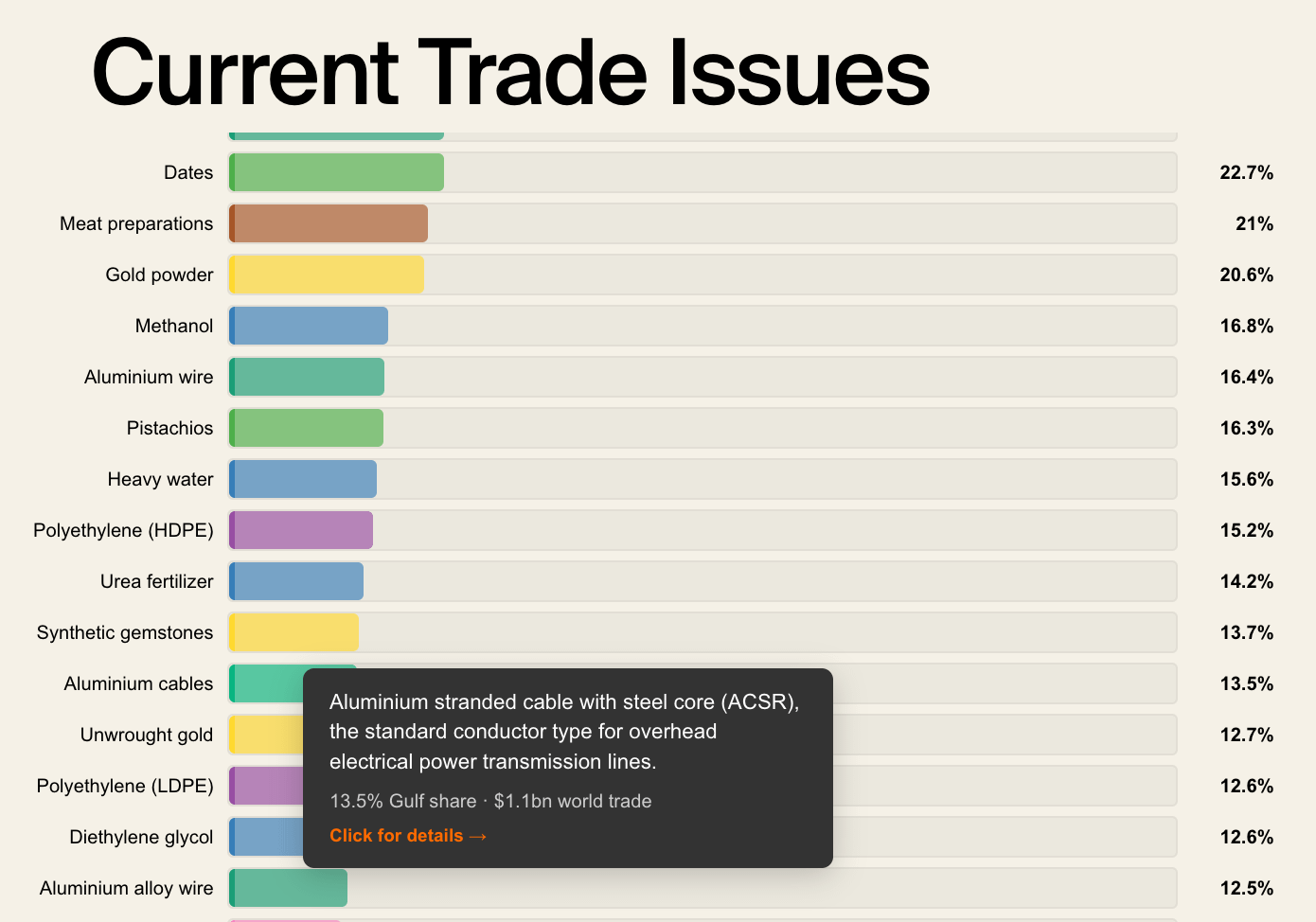
To no surprise to anyone, our existence is fragile and dependent on our ability to keep global trade alive. Technology is our damnation and savior. There are ways to transfer power from A to B without physical connection. Perfect for where generation is in one place but usage somewhere else. This is called power beaming, or wireless power transfer.
There are some recent developments that bring us closer to reality, with DARPA achieving a distance record in 2025 of 800W delivered over 30s across 8.6km; Starcatcher Industries transmitted 1.1 kW to COTS solar panels at ~1km distance with a multi-wavelength laser; Japan did a space-to-ground beam transfer of around 1 kW in Dec 2024.
Deployment scenarios
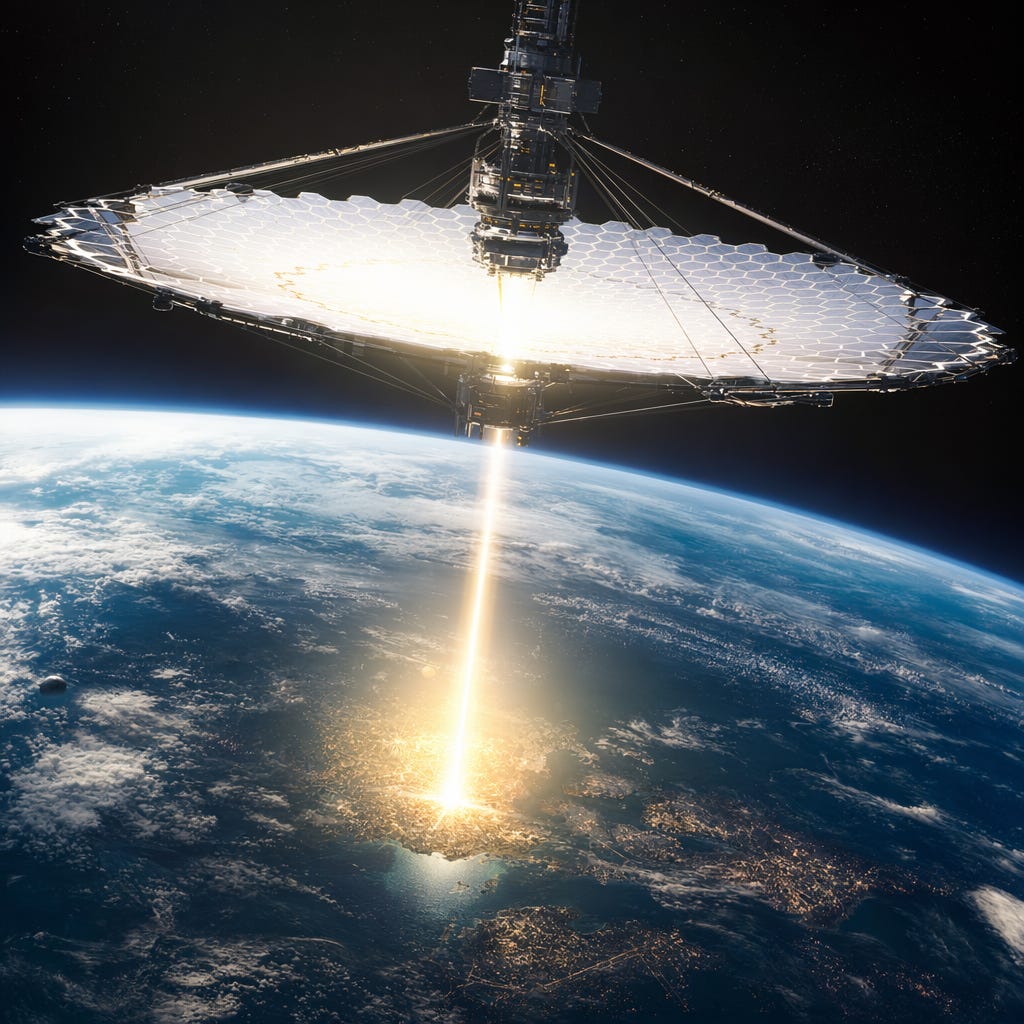
Just like with data centers in space, the argument goes that there’s a lot of sun in space, so why not harvest it and send it down to earth. Taken to it’s extreme we end up with Dyson Spheres which I’m all for, at some point. Climb the Kardashev Scale and so on. But, we can’t start at the end; it doesn’t make sense to light the candle before we made the cake. So before Dyson Spheres, there are simpler use cases in discussion on governmental levels, like NASA and ESA who analyzed Space Based Solar Power (SBSP) quite extensively. And on the private side, companies like TerraSpark, Aetherflux (though I heard they’re also doing data centers now), or Overview Energy. There’s a great article from Space Ambition on SBSP so I won’t go too deep into details here.
Where could power beaming be done:
Space to space
Space to atmosphere
Space to ground
Atmosphere to atmosphere
Atmosphere to ground
Ground to space
Ground to atmosphere
Ground to ground
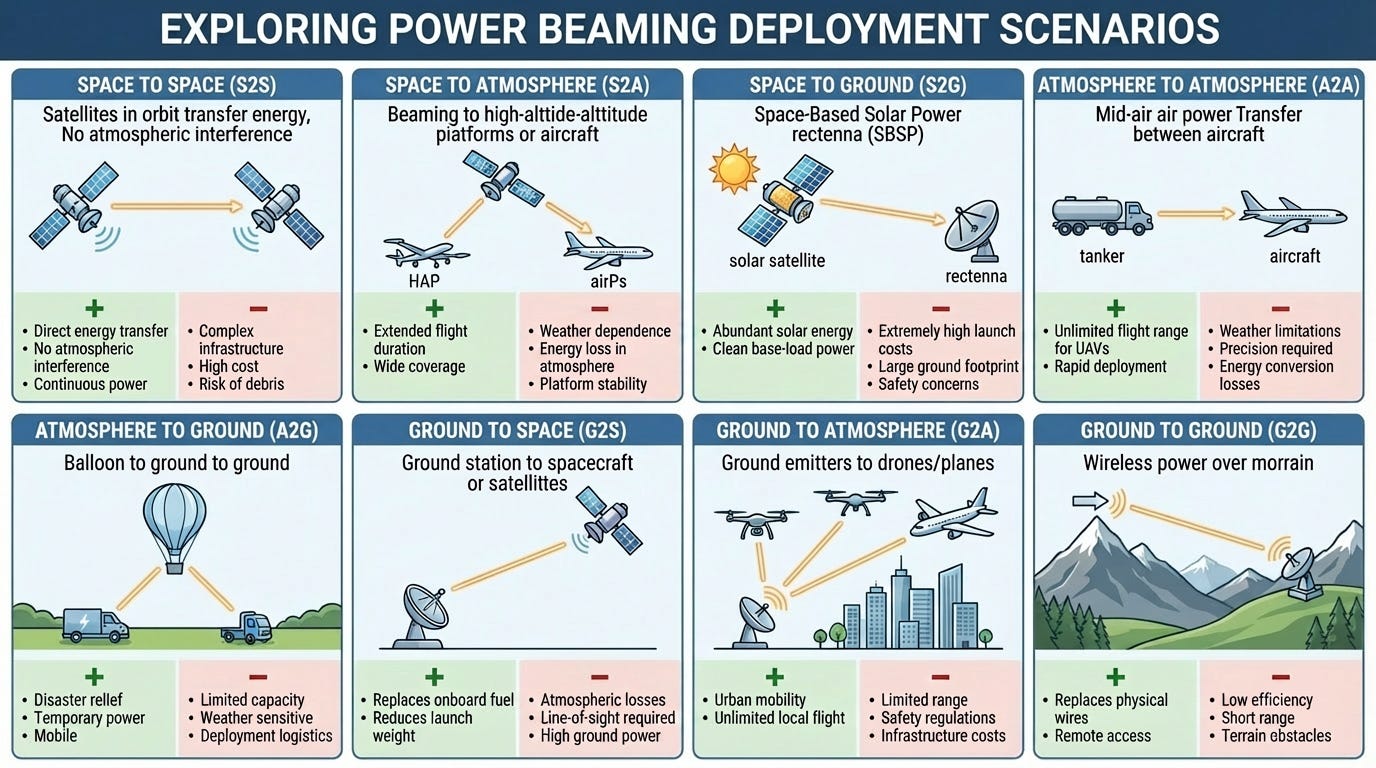
Out of these modes, we would like to figure what is most feasible and which won’t work for a long time. That analysis is dominated by one key metric: end-to-end efficiency as a percentage of energy available for usage at the receiving end, vs. energy at the transmitting end.
The core technical challenge is that current best-demonstrated figures range from 10-20% wall-to-wall, meaning 80-90% of input energy is lost to heat and conversion losses across the transmitter, beam propagation, atmosphere, and receiver chain.
Usually there are five sequential conversion/transmission steps that incur losses:
Power source - solar panels in space, or grid/generator on Earth
Transmitter conversion - electricity becomes photons (laser) or microwaves
Beam propagation - the beam crosses the distance, fighting divergence and whatever medium it passes through
Beam capture - the receiver collects what arrives (aperture and tracking efficiency)
Receiver conversion - photons or microwaves become electricity again
In these 5 steps, there’s one fundamental choice to make: lasers or microwaves to do the transfer.
Laser beaming is precise and compact. You can hit a small receiver from kilometers away. It dominates in vacuum and thin atmosphere: space-to-space, space-to-stratosphere, and controlled ground environments. But fog, rain, and clouds can eat up to ~99% of your beam, making it unreliable for anything that needs to work in all weather.
Ah, you might say, but what about cloud-clearing, essentially shooting away the clouds with lasers!? Well, let’s do the math shortly. There are two approaches:
another laser beam that evaporates the water droplets of clouds—the hard way as you’re boiling the column of water
or a filamentation technique pioneered by Wolf’s group at Geneva, where a femtosecond Ti:Sapphire pulse Kerr-self-focuses into a plasma filament
Wolf/Geneva is much less energy demanding (back of the envelope 3-10x less power vs. raw boiling) and has been experimentally tested for laser communications, not yet for power transfer. So let’s consider that: the optical overhead to maintain a 10-30cm cone of ~500m cloud of water content of 0.3g/m³ is something like 4-40kW. There’s no experimental data on how much of the water was cleared, so let’s assume something like 90%. This means our new transmission efficiency is unfortunately still only 5%. Even if we clear 99% of the water tx efficiency is just ~75%.
In addition, the efficiency of the filament pumped lasers aren’t amazing, plus payload laser, so to get to 4kW you’d need to supply around 30-80kW. And that assumes we cna achieve a multi-filament array over 500m. Still unproven AFAIK.
Once the payload is 100 kW–MW CW through a 30 cm column, thermal blooming inside the cleared channel becomes the limiting physics, not the cost of clearing. So Wolf/Geneva opens a window between "too small to be worth it" (sub-10 kW, clouds are a minor annoyance you can route around) and "blooming-limited" (hundreds of kW+, the cleared channel heats up and defocuses your beam).
Microwave beaming punches through weather but requires enormous receivers. It’s the only viable option for space-to-earth at scale, and the safer bet for any scenario that demands all-weather reliability. The tradeoff is physical footprint - a space-to-ground rectenna is measured in kilometers. Even the best beam forming won’t solve diffraction fundamentally.
The max gain is approximately proportional to aperture divided by the wavelength squared. Additionally, there are limits to how much power can be transmitted per unit bandwidth per unit solid angle. Discrete arrays are constrained by λ/2‑type spacing and spatial Nyquist; exceeding this creates unavoidable grating lobes.
You can trade aperture size, frequency, scan angle, sidelobes, bandwidth, and power, but you can’t design a system whose far‑field beam is narrower or more intense than allowed by these constraints for a given aperture, wavelength, and power.
End-to-end efficiency
Taking the above steps and applying some common efficiency numbers to it, we get compounding steps of losses.
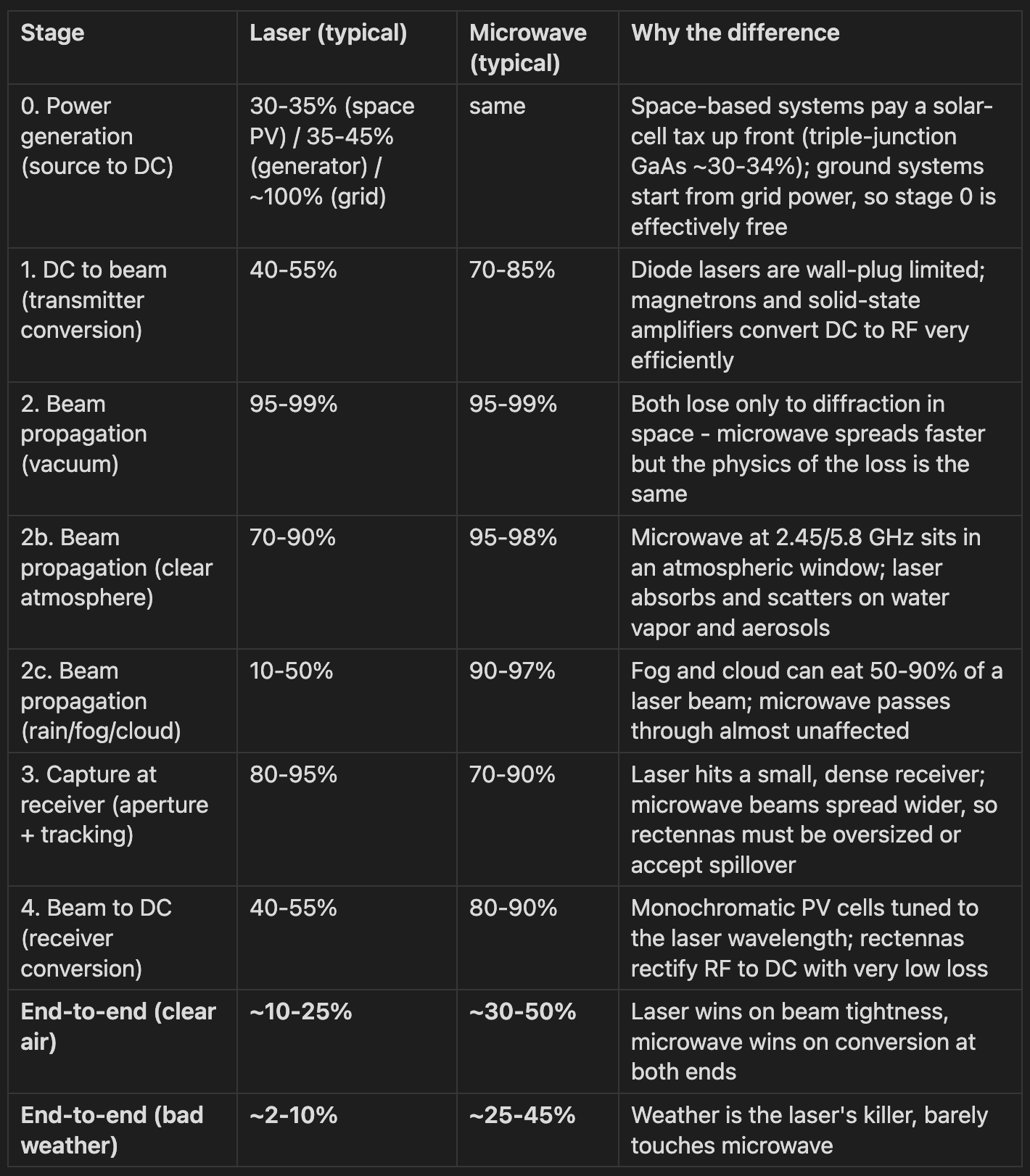
Without talking about the economics of any of this, we see quite clearly that very few use cases are robustly viable. Unless LCOE is close to zero. Operationally however, the goal must be to have weather independence on these power, at least to the degree that any power transfers can happen with sufficient accuracy.
Operational restrictions
The physical constraints start at the generation and end at the receiver end. In between it’s mostly safety and regulation issues that we’re facing. Turns out beaming loads of power through lasers or microwaves in free space might harm people, animals or equipment.
Generation is the same no matter what you need to do with the energy, but for space based specifically, or for air to ground beaming, you need to fly/orbit large structures of solar panels. In GEO it might be alright though, and GTO could be optimized for high perigee. On the ground, power could be coming from anywhere and more likely just use whatever mix the grid is on.
Transmission and DC conversion will likely not cause any larger issues, as it’s fairly standard infrastructure. We’re fairly good at turning power into photons/microwaves and back again. But for microwave transmitters the size is hard to avoid, meaning the infra will be fixed and large. For laser systems we get fairly high losses but infrastructure is physically smaller though not necessarily cheaper or simpler.
Microwaves use fairly developed systems like magnetrons or klystrons and can hit 80%+ efficiencies. Klystrons operate at very high voltages and gyrotrons (the MW-class cousins used in fusion heating) operating at high frequencies might jump between cavity modes. The supply chains are in construction in parallel with the fusion industry. They’re normally quite complex, and decently sized (telephone pole for ~1MW) so on the ground they aren’t limited, but in space or the air it might be an issue. One big constraint of magnetrons is that they can’t be phase-locked, hence phased array transmission will only work with klystrons/gyrotrons/solid-state.
Rectenna/receivers aren’t large issues for laser beams, with multi-junction or GaAs and the beam divergence being small means it doesn’t have to be a big PV. For microwave rectennas they will be large though, with power received growing linearly with surface area until the rectenna exceeds the beam footprint, at which point additional area catches nothing.. The beams aren’t uniform though, they are Gaussian, with most power in the center and less at the edges, which helps us.
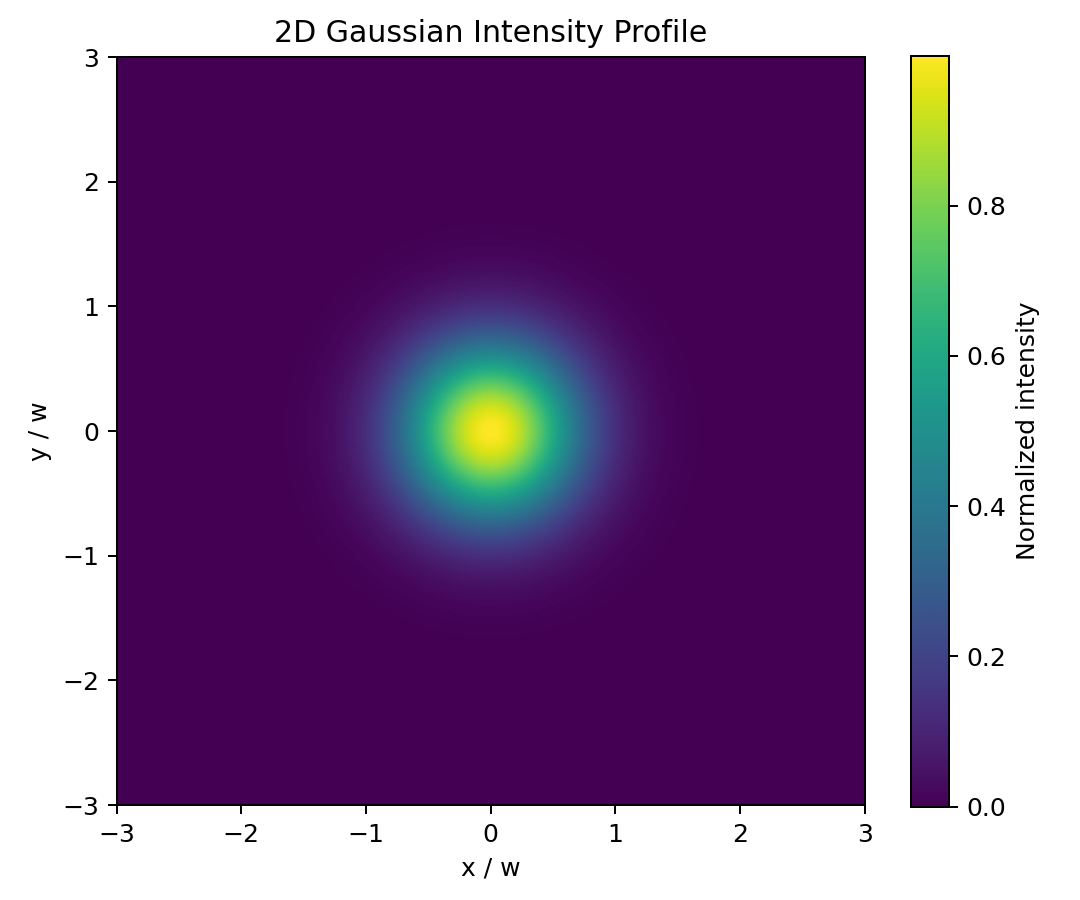
At GEO, rectenna area is essentially fixed by physics at tens of square kilometers regardless of power level below the per-element ceiling. The 1979 reference design’s 10×13 km footprint is set by diffraction: at 2.45 GHz the wavelength is 12.2 cm, so from 36,000 km through a 1 km transmit aperture you get a minimum spot of λR/D ≈ 4.4 km diameter. Area is bounded by physics, not power level.
This is why SBSP economics are so brittle: you pay for ~100 km² of land, civil works, and array fabrication whether your satellite delivers 1 GW or 5 GW. The fixed land cost dominates the LCOE at small scales. You need multi-GW output per station to amortize the rectenna infrastructure, which in turn demands km-scale transmit arrays in orbit, which is where the launch-cost and in-space-assembly problem comes in.
For drones and aircraft, the main problem is really economical and operational:
the physical infrastructure needed to beam power (high voltage grid connection+transmitter/antenna) becomes expensive and complex
for lasers, weather conditions will dominate (e.g., in the UK which is the most overcast developed country in the world according to my research) and destroy any reliability. Not even in the desert is it reliable, as dust storms will kill transmission efficiency
beaming microwaves at high power through the sky is not great for birds and bees, not to speak of other electronics or airplanes passing through, it would have to be a cleared airspace to be safe most likely (see more below)
Safety Considerations and Regulatory Landscape
Eye Safety
Near-infrared wavelengths (800-1400 nm) are particularly hazardous because they are invisible and do not trigger the blink reflex, yet can cause retinal damage below the threshold of pain. The Maximum Permissible Exposure (MPE) for continuous near-IR laser exposure is orders of magnitude lower than the intensities used in power beaming systems. This means we need:
Automatic beam shutoff systems triggered by obstruction detection
No-fly and no-go zones around active beam paths
Operational altitude limits (systems designed to beam upward avoid low-altitude human exposure)
You can also introduce closed-loop systems that turn off automatically should something disrupt the path.
FAA and Aviation
The FAA requires advance notification (30+ days) for outdoor use of Class 3B or 4 lasers (above 5 mW), with details on power, location relative to airports, and control measures. Pointing a laser at aircraft is a federal crime with fines up to ~$32k per violation. In 2024, pilots reported >12,000 laser strikes - demonstrating the regulatory sensitivity around aviation laser safety. Power beaming systems operating near airports or flight paths face significant coordination requirements.
Regulatory Gap
There is currently no comprehensive regulatory framework specifically for high-power beam-path operations in public airspace. Each major demonstration (DARPA at White Sands, Star Catcher at Kennedy Space Center) has operated on military or controlled NASA land, avoiding the public airspace regulatory complexity. Commercial deployment in civilian areas will require new frameworks from the FCC (microwave frequency licensing), FAA (airspace coordination), and potentially OSHA (workplace laser safety).
LTA safety
For lighter-than-air aircraft, i.e., balloons/aerostats and airships, we need to consider the heating of the envelope and the contained gas inside. This could either harm the structural integrity of the aircraft, or make it change altitude. Some back-of-the-envelope calculations, make laser the higher risk here, as harming the envelope would need 3-4x OOMs less energy to cause damage. If the LTA is helium-filled, then the only way to heat up the gas would be by heating up the envelope or structure. Even 3kW into 1,200 kg helium would only add ~2 mK per second. And given the volume there’s a large surface area with cold air around it. For a laser though, it’s enough that it misses the receiver slightly and hits the LDPE film. It would likely only need 5-20s of 3kW laser to structurally harm the envelope.
So when does this actually make sense?
If your expectation is a general-purpose replacement for the grid then we’re far off, and Dyson Sphere’s aren’t close yet. The physics stack doesn’t compete with copper cables, battery storage, or even diesel generators on $/kWh. It competes with them only when they’re infeasible: when you can’t run a cable, can’t carry a battery, or can’t convoy fuel through contested territory.
That’s a smaller market than we might like, but it’s not zero. Four tiers, in descending order of how much I’d bet on the timeline working out and there being any economic case for them:
Tier 1 - Military drone persistence (2026-2028). PowerLight is under contract with CENTCOM to demonstrate “infinite flight” for Group-2 UAVs in 2026. DARPA’s POWER program is targeting 5 kW at 120 miles by ~2028 via relay drones. So it’s interesting to someone. The military doesn’t care about $/kWh the way a utility does; they care about not sending fuel convoys into contested territory and about keeping eyes in the sky without landing. A remotely-powered drone that never lands is worth more than the energy it wastes.
BUT: the real technology need isn’t power beaming itself; what would pay here is persistent infrastructure. Caveats on power beaming for this:
this type of power beaming is mostly proven for low altitude, clear skies.
Deploying this in e.g., Ukraine or the High North where conditions are often overcast or foggy will have very different performance parameters, even for microwave.
Not harming the envelope will be hard, and setting up massive (20m+ diameter) antennas in contested environments with huge power supply is an issue
If we can keep eyes-in-the-sky or cell towers-in-the-sky permanently without having to connect huge microwaves on the ground (which can be taken out) then that’s preferable.
Tier 2 - Orbital power relay (2026-2030). Sunlit satellites powering eclipsed ones. Star Catcher is building toward this. Best physics of any scenario (vacuum, no weather, no diffraction hell), and the economics work because the alternative is bigger batteries or accepting blackouts in shadow. Not a consumer market, but a real one.
Tier 3 - Disaster and remote power (2027-2032). After an earthquake flattens the grid, you can’t run a cable. NTT and MHI have demonstrated ~15% efficiency through real atmospheric turbulence - enough for emergency comms, water pumping, medical equipment.
Tier 4 - Space-based solar power (2035+). The grand dream. Collect solar 24/7 in orbit, beam it down. Physically demonstrable (JAXA OHISAMA did it), economically brittle: you pay for a km² rectenna regardless of the power level running through it. ESA’s SOLARIS models suggest €88-155/MWh by 2040 - competitive with peaking plants but not with terrestrial solar at $20-60/MWh. I’d bet on it eventually. I wouldn’t bet a fund on the timeline.
Special shout-out to Big Space Lamp (TM), companies wanting to deliver lighting from space, e.g., like Reflect Orbital running constellations of huge mirrors. This sounds like the worst of all use cases and I’m not enlightened (hah) when it comes to the investment strategy there. Professional, mobile lighting towers might be a market of about $0.6-$2.5B but not sure what the EBITDA look like when you need to run a constellation to unlock it…
The Hormuz data at the top of this post is troubling, but wireless power doesn’t save anyone from a global copper-logistics problem at any realistic scale this decade. What it does change is the arithmetic at the small end: a forward operating base doesn’t need a diesel convoy if it can pull power from a rear-area laser. A post-disaster hospital doesn’t need to wait for the grid to come back. A satellite doesn’t need a bigger battery for every eclipse.
Considering the alternatives though, like tethered drones, VLEO and stratospheric airplanes, there seem to be better and more economically feasible solutions to the problems.
The shortest path (ground-to-ground) has the worst physics. The longest path (GEO-to-ground) has the best business case in theory and the worst capex in practice. The one in between (orbit-to-orbit) is where I’d look for the cleanest near-term outcome.
I would never whip a donkey
This is actually a true story told by a Caribbean telco executive on how they power their 5G net